
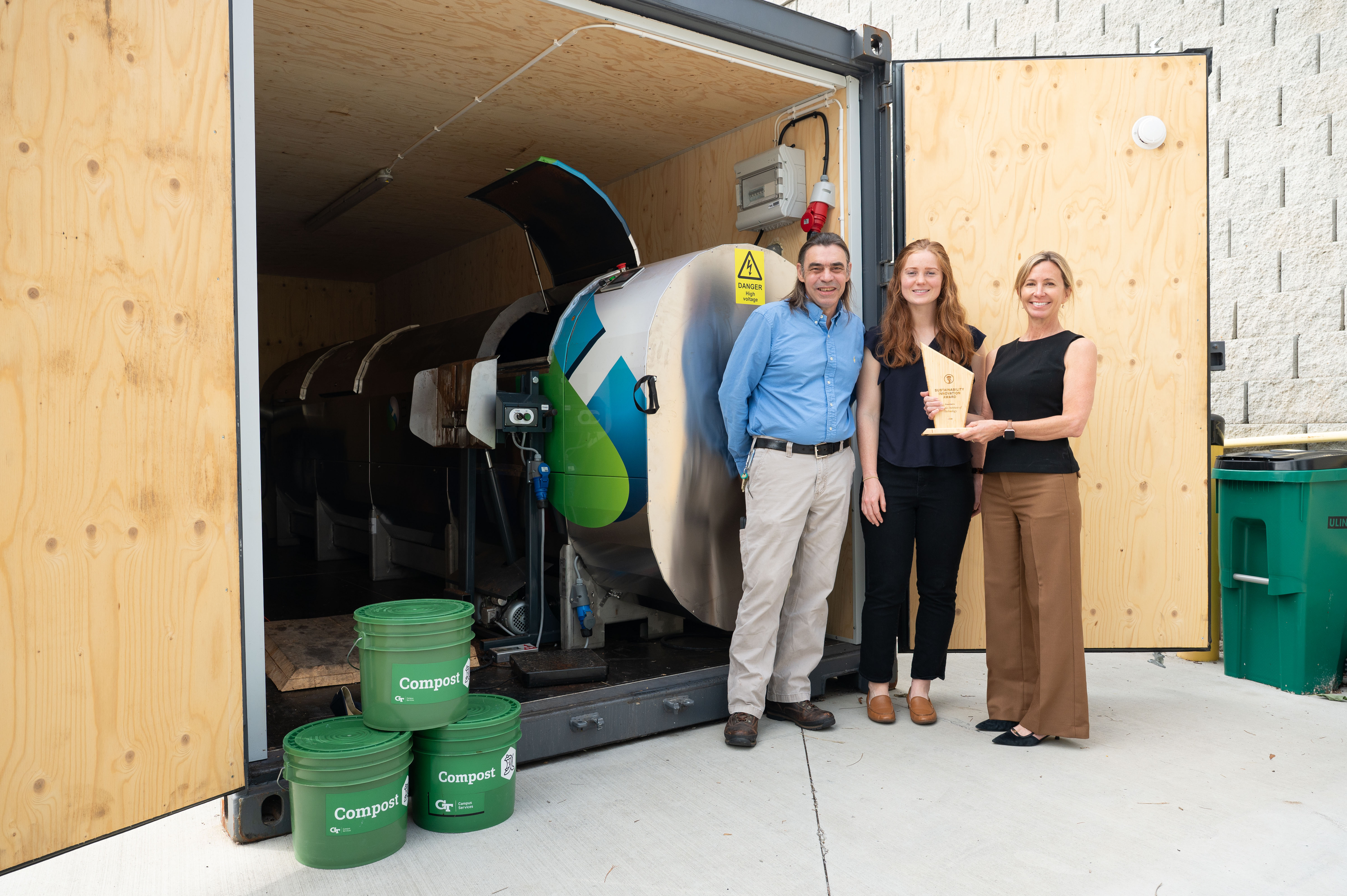
Georgia Tech’s in-vessel composting program earns national recognition.
Georgia Tech’s commitment to transforming waste into a valuable campus resource has earned national recognition. The Institute recently received the APPA Sustainability Innovation Award, honoring the Office of Sustainability’s pioneering in-vessel composting program, which is helping Georgia Tech reduce waste, lower emissions, and create a more sustainable campus.
The award is presented by APPA: Leadership in Educational Facilities, an international association that serves more than 1,300 educational institutions and facilities professionals. APPA’s Sustainability Innovation Award recognizes educational institutions that implement transformative programs or processes that enhance service delivery, improve environmental performance, reduce costs, and support student success through environmental stewardship. Recipients are selected based on innovation, sustainability impact, adaptability to other institutions, and measurable benefits to their campus communities.
Turning Food Waste Into a Campus Resource
Georgia Tech’s award-winning in-vessel composting program exemplifies how innovative infrastructure can support ambitious sustainability goals.
The Office of Sustainability received a Recycling and Waste Diversion grant from the Georgia Environmental Protection Division in 2024 to implement the composter, which arrived on campus last year. A student-staffed collection program (using e-bikes and an electric golf cart) captures food scraps and compostable materials from campus housing and dining facilities, and processes them on-site using a specialized in-vessel composting system. This reduces the weight of material by approximately 80%, decreasing the demand for off-campus hauling.
Unlike traditional composting methods, the enclosed system carefully controls temperature, airflow, and moisture, accelerating decomposition while minimizing odors and reducing the space required for processing. In just over six months, three student assistants have collected more than 5 tons (10,000 pounds) of materials from various campus locations.
“Georgia Tech has grown a strong composting program thanks to high levels of commitment from Tech Dining, Housing, and Campus Services, plus a strong hauling partner,” said Abby Bower, program and portfolio manager in the Office of Sustainability. “The in-vessel composter has added an exciting new layer to our composting services. It’s been fun to see our students embrace the technology and share their ideas for how to improve campus operations.”
By processing organic waste on campus, Georgia Tech diverts significant amounts of material from landfills, where food waste would otherwise generate methane, a potent greenhouse gas. The program supports the Institute’s broader sustainability and circular economy objectives by keeping resources in use and reducing environmental impacts.
Why Georgia Tech Stood Out
According to APPA, Sustainability Innovation Award recipients demonstrate creativity, measurable environmental and economic benefits, community impact, and the ability to serve as a model for other institutions.
Georgia Tech’s in-vessel composting initiative stood out because it:
- Demonstrates an innovative approach to campus waste management.
- Diverts food waste from landfills and reduces greenhouse gas emissions.
- Creates a closed-loop system that turns waste into a useful resource.
- Provides educational opportunities for students and the campus community.
- Offers a scalable model that can be replicated by other colleges and universities.
The program reflects the collaborative work of the Office of Sustainability and campus partners to create practical, measurable solutions that advance Georgia Tech’s sustainability commitments.
A Model for the Future
Receiving the APPA Sustainability Innovation Award highlights Georgia Tech’s role as a leader in sustainable campus operations and environmental stewardship. As institutions across the country seek innovative ways to reduce waste and meet climate goals, Georgia Tech’s in-vessel composting program demonstrates how thoughtful investments in infrastructure can deliver lasting benefits for both the campus community and the environment.
Additional Images
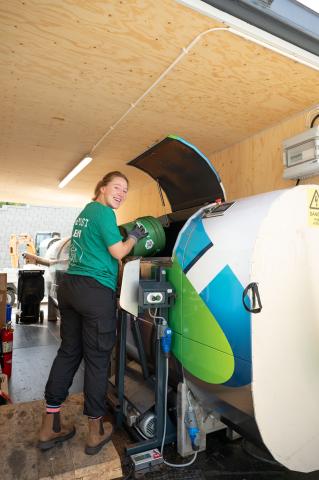
<p>Katherine Sanders, compost student assistant, at the in-vessel composter site.</p>