
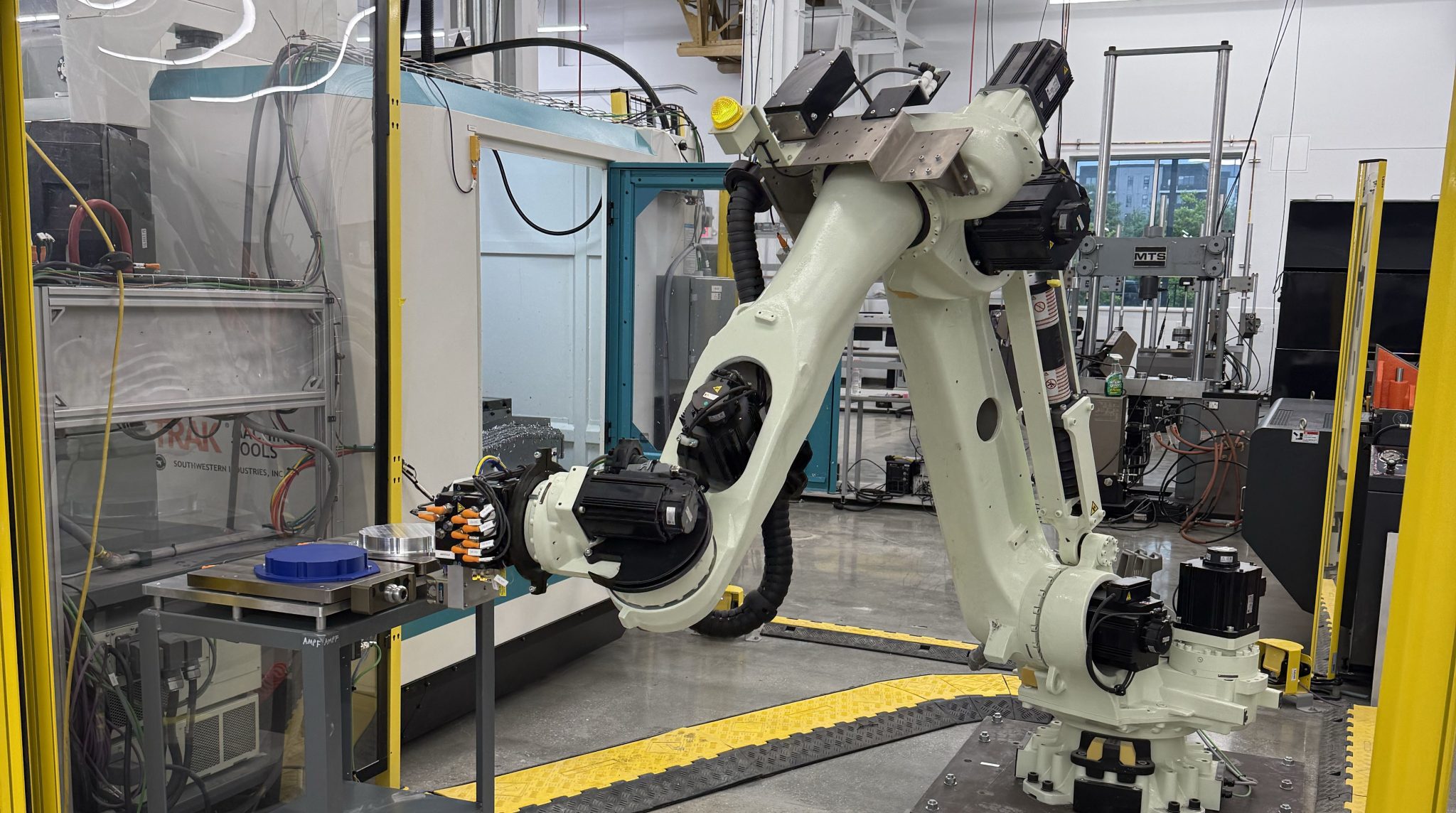
The cloud laboratory will enable researchers nationwide to conduct AI-driven experiments using the Advanced Manufacturing Pilot Facility's materials and manufacturing equipment. (Credit: Georgia AIM)
The cloud lab will give researchers nationwide remote access to Georgia Tech’s Advanced Manufacturing Pilot Facility, pairing AI with autonomous experimentation to accelerate new materials discovery.
Advancements in technology are key to a nation’s ability to innovate and compete. Next-generation infrastructure, manufacturing, energy systems, electronics, and even medicine require new materials with capabilities that existing materials can’t provide.
But discovering and vetting those materials can be slow, expensive, and hands-on, requiring researchers to prepare samples, run experiments on specialized equipment, and repeat the cycle through trial and error.
Now, Georgia Tech aims to deliver a paradigm shift in materials and manufacturing research with a new Programmable Cloud Laboratory that will leverage artificial intelligence (AI), simulation, and autonomous experimentation to accelerate that process dramatically.
Built upon Georgia Tech’s Advanced Manufacturing Pilot Facility (AMPF), a core facility of the Georgia Tech Manufacturing Institute (GTMI), the cloud lab will allow researchers across the country to direct work remotely, refine experiments based on results and AI recommendations, and tap into advanced manufacturing capabilities without spending weeks on-site. In effect, the cloud lab will bring the facility to the researcher.
“By making advanced manufacturing and AI-driven experimentation accessible from anywhere, we are accelerating the discovery of critical new materials and shaping the future of U.S. innovation,” said Tim Lieuwen, executive vice president for Research. “Georgia Tech is proud to provide the world-class infrastructure to help meet this national need and strengthen our research partnerships.”
The cloud lab is supported by $18.1 million from the National Science Foundation (NSF) and is part of a broader effort to build a national network of 20 AI-enabled cloud laboratories. The labs are designed to work together, eventually allowing researchers to combine capabilities and workflows across the network. The new research ecosystem will connect advanced scientific infrastructure with expertise across the country.
“Researchers can ask a question, have work recommended by AI agents, have experiments carried out at the facility using robotics, and get the results back,” said Aaron Stebner, GTMI associate director, Eugene C. Gwaltney Jr. Chair, James R. and Sarah R. Borders Faculty Fellow, and professor in the School of Materials Science and Engineering and the George W. Woodruff School of Mechanical Engineering (ME). “They can use AMPF resources to advance their own research without having to be experts in each piece of equipment or send students to AMPF for weeks at a time.”
By lowering costs and barriers to conducting that research, Stebner said, the cloud lab will dramatically expand who can take advantage of AMPF’s capabilities.
A Self-Driving Research Lab
AMPF is a mixed-use facility where both industry and academic partners can discover new materials and do manufacturing research. Today, the facility is approaching autonomous workflow capabilities across about 38 pieces of equipment. Through the cloud lab, the team aims to expand automated and autonomous workflows to more than 100 of AMPF’s 160 pieces of equipment.
The cloud lab will also bring together stages of materials development that have traditionally happened separately, allowing researchers to explore materials discovery, manufacturing, testing, and scale-up within the same research environment.
Pascal Van Hentenryck, director of the NSF AI Institute for Advances in Optimization and A. Russell Chandler III Chair in the H. Milton Stewart School of Industrial and Systems Engineering, said the automation extends beyond individual pieces of equipment. Robots can operate machines and move materials from one station to another, physically carrying out workflows requested by researchers from afar. AI will help determine which machines and robots are needed for each task and manage their movements across the facility.
Van Hentenryck compared the process to following a recipe.
“When you cook, you have a recipe, and the recipe tells you what you have to do,” Van Hentenryck said. “You don’t need to understand exactly how the stove is working. You just need to know what you need to accomplish with it.”
AI agents will take those high-level “recipes” from researchers, translate them into detailed workflows, and coordinate experiments, simulations, and data flows across the facility.
The system will rely in part on digital twins — virtual models of the facility that can help plan, monitor, and improve experiments before and during execution. Van Hentenryck said the system is also designed to learn from each run, improving how machines are tuned and how future workflows are scheduled.
The project will integrate Duke University’s Automatic FLOW for Materials Discovery software platform, led by professor Stefano Curtarolo, to connect computational discovery with physical experimentation and help researchers more rapidly identify and evaluate promising new materials. Contextualize, led by founder and CEO Branden Kappes, will provide the data platform that seamlessly connects researchers, instruments, data, and IT systems across the distributed network. Tech AI will also contribute to the project as part of the broader research team.
The cloud lab will help bridge a longstanding gap between research and industrial adoption. Companies can be reluctant to interrupt working production lines to test unproven technologies, while startups and academic researchers often lack access to industrial-scale facilities where they can demonstrate that their ideas work. AMPF provides an environment where emerging technologies can be tested and de-risked without disrupting commercial production.
“The cloud lab will give industry partners and manufacturers the ability to evaluate new ideas before they commit to large-scale deployment,” said Tom Kurfess, executive director of GTMI and Agustin A. Ramirez/HUSCO International Distinguished Chair in Fluid Power Systems in ME. “This initiative will shorten development cycles and make it easier to bring promising technologies into production, enabling our partners and us to innovate at the speed of thought.”
Expanding Access to Advanced Research
The project aims to serve more than 400 users from 150 academic, industry, and government institutions, with more than half participating remotely.
“Making these autonomous labs available to a very wide community is key to innovation,” Van Hentenryck said. “You just give a lot of people the opportunity to try things out.”
The cloud lab builds on a larger effort Georgia Tech has pursued through AMPF for years: integrating AI, automation, and advanced manufacturing to create a flexible research environment that can evolve with technology, expand access, and strengthen U.S. leadership in materials and manufacturing.
For Stebner, the cloud lab represents a critical next step in bringing that vision to life.
“We are six years into this effort, and we’re already at a place I thought would take us 20 years to reach,” Stebner said. “This cloud lab is going to take us to a level of technology, research, leadership, and access that I didn’t know if we would reach by the end of my career.”